🚀 Meet MIRANOVA TECHNOLOGIES at LOUNGES 2026 in Karlsruhe (March 24–26).🚀
Join us at the event for the latest in cleanroom & process technology! LOUNGES 2026 Karlsruhe - Cleanroom Processes




Welcome to MIRANOVA TECHNOLOGIES
This comparison is critical because marketing often conflates "UV" into a single category. In reality, these are vastly different technologies with distinct failure modes, costs, and risks.
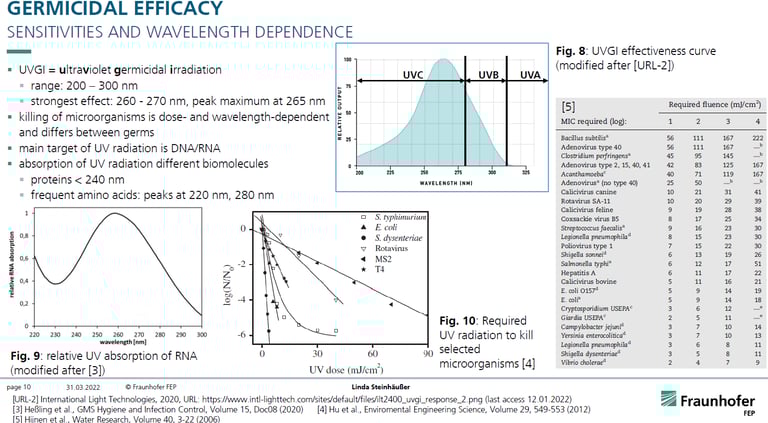
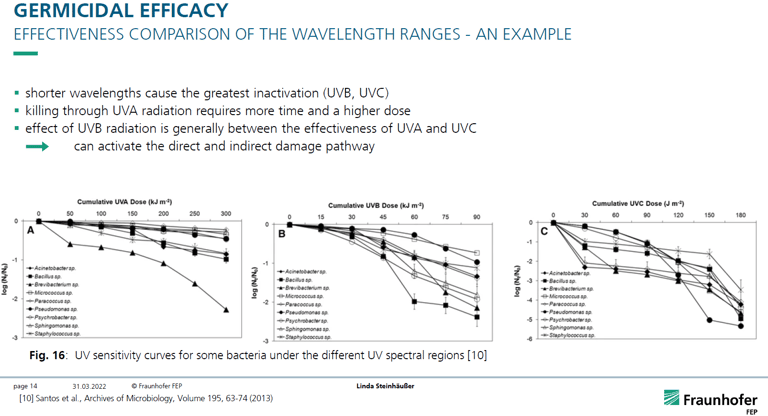
The "Dark" Biology (Wavelength Nuances)
Focus: Deep diving into 222nm vs 265nm vs 254nm.
Week 4: "Zombie" Bacteria (Photoreactivation)
* The Unknown: UV-C doesn't always kill bacteria instantly; it damages their DNA. If treated bacteria are subsequently exposed to visible blue light (sunlight or room lights), some can repair their DNA using an enzyme (photolyase).
* The Risk: A lab test in the dark shows 99.9% kill. In a lit room, the bacteria "wake up" an hour later.
* The Opportunity: Designing systems that deliver a "lethal overdose" rather than the bare minimum, or using specific wavelengths (265nm LED) that damage proteins, making repair harder.
The following data reflects the reality of 2026—distinguishing between what is printed on the datasheet and what happens in the field.
Comparative Snapshot: The "Real" Numbers
| Metric | 254nm Hg (Low Pressure) | 222nm Module (Filtered KrCl) | 265nm / 280nm LEDs | 405nm (Violet Blue) | Pulsed Xenon (PX-UV) |
|---|---|---|---|---|---|
| Price / UV-C Watt | $0.50 – $2.00
(Cheap commodity) | $500 – $1,000
(Extremely High) | $20 – $100
(Dropping fast) | $1 – $5
(Standard LEDs) | N/A
(Sold as capital equipment) |
| Wall-Plug Efficiency
(UV output / Input Power) | 30% – 35%
(The Efficiency King) | < 1% – 2%
(Energy inefficient) | 3% – 8%
(Improving, but still hot) | 30% – 45%
(Efficient, but not UV-C) | < 1%
(Inefficient, relies on peak power) |
| Heat Waste | Low density.
Spread over long tube. | Extreme.
Requires active cooling (fans). | Extreme (Point Source).
Requires massive heatsinks. | Low/Medium.
Standard LED management. | High bursts.
Requires rest periods. |
| Real L70 / L80
(Useful Life) | 9,000 – 16,000 hrs
(Very Reliable) | 1,500 – 3,000 hrs
(Fails early due to drivers/seals) | 5,000 – 10,000 hrs
(Highly temp. dependent) | 25,000+ hrs
(Standard lighting life) | ~2M Pulses
(Flashlamp consumable) |
| Sudden Fail Rate | < 1%
(Predictable fade) | 10% – 15%
(Infant mortality & driver death) | 5% – 10%
(Thermal runaway) | < 1%
(Very reliable) | Low
(Predictable limit) |
| Germicidal Efficacy
(Ref: 265nm = 100%) | 80% – 85%
(Near peak DNA absorption) | ~90% – 100%
(Better absorption, less penetration) | 100% (265nm)
70% (280nm) | < 0.1%
(Oxidative stress, not DNA) | High
(Brute force broad spectrum) |
| Ozone Creation | Zero
(If doped glass is used) | YES
(Must be managed/vented) | Zero
(Narrow band emission) | Zero | YES
(Broad spectrum <240nm) |
| Material Degradation | High
(Deep structural damage) | Surface Only
(Absorbed top layer; less structural) | Medium/High
(Depends on intensity) | None
(Safe for plastics/fabrics) | High
(High peak energy) |
Detailed Analysis by Category
1. The Efficiency Paradox (Wall-Plug Efficiency)
* 254nm (Mercury): Remains the only "green" choice regarding energy consumption. For every 100W of electricity, you get ~30W of germicidal UV.
* 222nm (Excimer) & LEDs: Are heaters first, light sources second. 222nm converts 98% of input energy into heat. This forces the use of fans (which fail) or massive heatsinks (which are heavy/expensive).
* Note: If you install 222nm, your air conditioning bill will go up slightly, unlike with 254nm or 405nm.
2. Germicidal "Gold Standard" vs. Reality
* 265nm LED: This is the precise peak of DNA absorption. It is the "perfect" killer. However, manufacturing 265nm chips is difficult and expensive.
* 280nm LED: Manufacturers often substitute 280nm because it is cheaper and has higher optical power. It is roughly 30% less effective per watt than 265nm, but they compensate by overpowering it.
* 405nm (Visible Blue): This is not UV. It kills bacteria via oxidative stress (exciting porphyrins), not by breaking DNA. It requires massive doses (hours of exposure) to kill what UV-C kills in seconds. It is for "clean maintenance," not "disinfection."
3. The Ozone Issue
* 222nm: Unlike common marketing claims, 222nm light does generate ozone because it interacts with oxygen (the Chapman cycle starts below 242nm). While the quantity is often below safety limits in large rooms, in small, enclosed fixtures, ozone can build up and degrade the fixture's own internal components (wires, reflectors).
* 254nm: Standard commercial lamps use "doped" quartz that blocks the 185nm ozone-producing line entirely.
4. Material Degradation (The "Rot" Factor)
* 254nm: Penetrates deep into plastics (PVC, wire insulation, housings), causing them to become brittle and crack (structural failure).
* 222nm: Because 222nm is so heavily absorbed by proteins and polymers, it does not penetrate deep. It "chalks" the very top micron of the surface but often leaves the structural integrity underneath intact. 222nm is safer for your room's materials than 254nm.
Summary Verdict
* If you need cost-effective, high-volume disinfection (Air Ducts / Water):
* Winner: 254nm Low Pressure Mercury. Nothing beats its price-per-watt or efficiency.
* If you need safe, occupied-space disinfection:
* Winner: 222nm (with caution). It is the only option safe for human skin, but you must accept the high price ($1,500+), short lifespan (1,500 hrs), and cooling requirements.
* If you need compact, embedded disinfection (Water bottles / Medical devices):
* Winner: 280nm LEDs. 265nm is too expensive; 280nm is "good enough" and cheap enough for small-scale consumer goods.
* If you want "Continuous Cleaning" without safety gear:
* Winner: 405nm. Just know it will not stop a sudden viral outbreak; it only suppresses bacterial growth over time.
The 222nm illusion:
Based on current market data and technical documentation as of early 2026, here is the rough pricing and realistic reliability data for the Ushio Care222® B1 module.
1. Rough Price (Single Module)
* Estimated Price: $1,500 – $1,800 USD (for the module alone).
* Finished Fixture Price: If you are buying a "ready-to-use" downlight or wall unit (e.g., UV-Downlight222 or similar), the price is typically $2,200 – $2,500 USD.
* Note: Ushio primarily sells these modules B2B (business-to-business) to OEMs. If you are an individual trying to buy just one, you will likely pay the higher end of this spectrum or need to buy a finished fixture to get the module.
2. Real vs. Advertised Lifespan (L70)
This is where the discrepancy you suspected exists. While the technology has improved, there is a massive gap between the "lab" data and the "guaranteed" reality.
| Metric | Hours | Context |
|---|---|---|
| Advertised L70 | 11,000 hours | Ushio released "life test data" in 2022 claiming 30% degradation (L70) occurs only after 11k hours of continuous run time. |
| Real / Warranted Life | ~1,500 – 3,000 hours | Most distributors and OEM partners only warrant the module for 1,500 hours of active operation (or 2 years, whichever comes first). |
Why the huge gap?
* Cycling Stress: The 11,000-hour claim is often based on continuous operation or ideal duty cycles. In the real world, these modules are frequently pulsed (turned on/off) by motion sensors or timers. While Excimer lamps are better at switching than legacy mercury lamps, the electronics (inverter/driver) and the thermal expansion stress on the lamp seals often cause failure long before the gas mix degrades.
* Filter Degradation: The specialized optical filter (critical for safety to block 230nm+ wavelengths) can degrade or solarize over time, reducing effective output even if the lamp itself is still firing.
* Thermal Sensitivity: The B1 module is extremely sensitive to heat. If the OEM fixture does not have perfect heatsinking, the output drops precariously, and the lifespan is cut drastically.
3. Sudden Failure Rate
Specific "sudden failure" statistics (e.g., "3% fail before 100 hours") are proprietary and not published, but we can infer the "real" risk from the warranty terms and integrator feedback:
* Infant Mortality: High. If a module is going to fail, it usually happens in the first 50–100 hours due to micro-leaks in the lamp glass losing the KrCl gas pressure.
* Driver Failure: The high-voltage inverters required to drive these excimer lamps are the weak link. In real-world installations, reports suggest the inverter/driver fails before the lamp bulb does.
* Output "Drop" vs. "Fail": Sudden failure (going dark) is less common than "sudden ineffectiveness." A common failure mode is not that the light turns off, but that the intensity drops below germicidal efficacy suddenly due to thermal overload, while the light appears to be on.
Recommendation
If you are integrating this for a critical application:
* Budget for replacement every 3,000 hours, not 11,000.
* Active Cooling is mandatory. Do not rely on passive cooling if you want to get anywhere near the advertised life.
* Check the warranty terms of the specific vendor you buy from; most will cap you at 1,500 active hours.
Here is the updated, rigorous assessment for 222nm and 405nm.
I have explicitly sharpened the warnings regarding European compliance (Directive 2006/25/EC) and the often-overlooked biological effects of intense blue light.
1. 222nm Far-UV-C (Krypton-Chloride Excimer)
The "Human Safe" marketing myth vs. European Regulatory Reality.
| Proven Facts | The Engineering Limitations |
|---|---|
| Safety Relative, Not Absolute: 222nm is safer than 254nm because of its low penetration into the stratum corneum. However, it is not benign. It is still high-energy ionizing radiation. | The "Dose vs. Law" Conflict: European Directive 2006/25/EC (and ICNIRP guidelines) set strict Exposure Limit Values (ELVs).
The daily limit for 222nm is often ~22–25 mJ/cm² (depending on exact calculation).
The Trap: To achieve Log 2 reduction on resilient molds or spores, you often need >50 mJ/cm². You cannot legally deliver the required cleaning dose while humans are present without violating labor safety laws. |
| Filter Dependency: Commercial lamps require distinct optical filters to block hazardous >230nm emissions. | Filter Aging & Damage: These filters are fragile. A micro-crack or coating degradation allows carcinogenic wavelengths (230-280nm) to pass through. The lamp looks identical, but it is now a standard hazard. |
* The Hidden Cost & Danger:
* Regulatory Non-Compliance: Implementing 222nm under the assumption it is "unregulated" is a legal minefield. If an operator develops skin erythema or eye irritation, the "human safe" marketing brochure will not protect you in court against the EU Artificial Optical Radiation Directive.
* False Economy: You pay a massive premium (5x-10x cost vs. standard UV) for a "safe" lamp, only to find out you must still shield it or duty-cycle it to stay under the ELV, negating the benefit of buying it in the first place.
2. 405nm "Decontaminating" Blue Light
The "Harmless" Visible Light Trap.
| Proven Facts | The Engineering Limitations |
|---|---|
| Mechanism: Excites porphyrins to create Reactive Oxygen Species (ROS). | Spectral Drift & UV-A Generation: LEDs are not perfect monochromatic lasers; they have a "tail." As chips age or overheat, the spectrum shifts. A "405nm" peak often has a tail dragging down into the 380nm-390nm UV-A range. You are technically irradiating staff with UV-A, which penetrates deeper into the skin (dermis) than UV-C, causing aging and oxidative stress. |
| Human Perception: Visible violet/blue light. | Blue Light Hazard (L_B): High-intensity blue light (400-500nm) causes photochemical damage to the retina (Blue Light Hazard function B(\lambda)). It is not "eye safe" at high intensities; it accelerates macular degeneration. |
* The Hidden Cost & Danger:
* The "Blue Light Sickness": Operators working under intense monochromatic blue/violet light report higher rates of migraines, severe eye strain, and nausea.
* Circadian Disruption: 460nm-480nm suppresses melatonin, but 405nm at high intensity also impacts circadian rhythms. Installing this in 24/7 shifts can lead to sleep disorders and operator error.
* Material Surprises: While it doesn't degrade plastics as fast as UV-C, the UV-A component (from spectral drift) will still yellow polycarbonates and fade labels over time.
Not UV-C Light is alike.
Role and Impact of UV-C wavelengths.