🚀 Meet MIRANOVA TECHNOLOGIES at LOUNGES 2026 in Karlsruhe (March 24–26).🚀
Join us at the event for the latest in cleanroom & process technology! LOUNGES 2026 Karlsruhe - Cleanroom Processes



Light and Decontamination
How wavelengthes impact microbial decontamination efficiency
3/31/2026
The Context Missing from Your Decontamination Specs
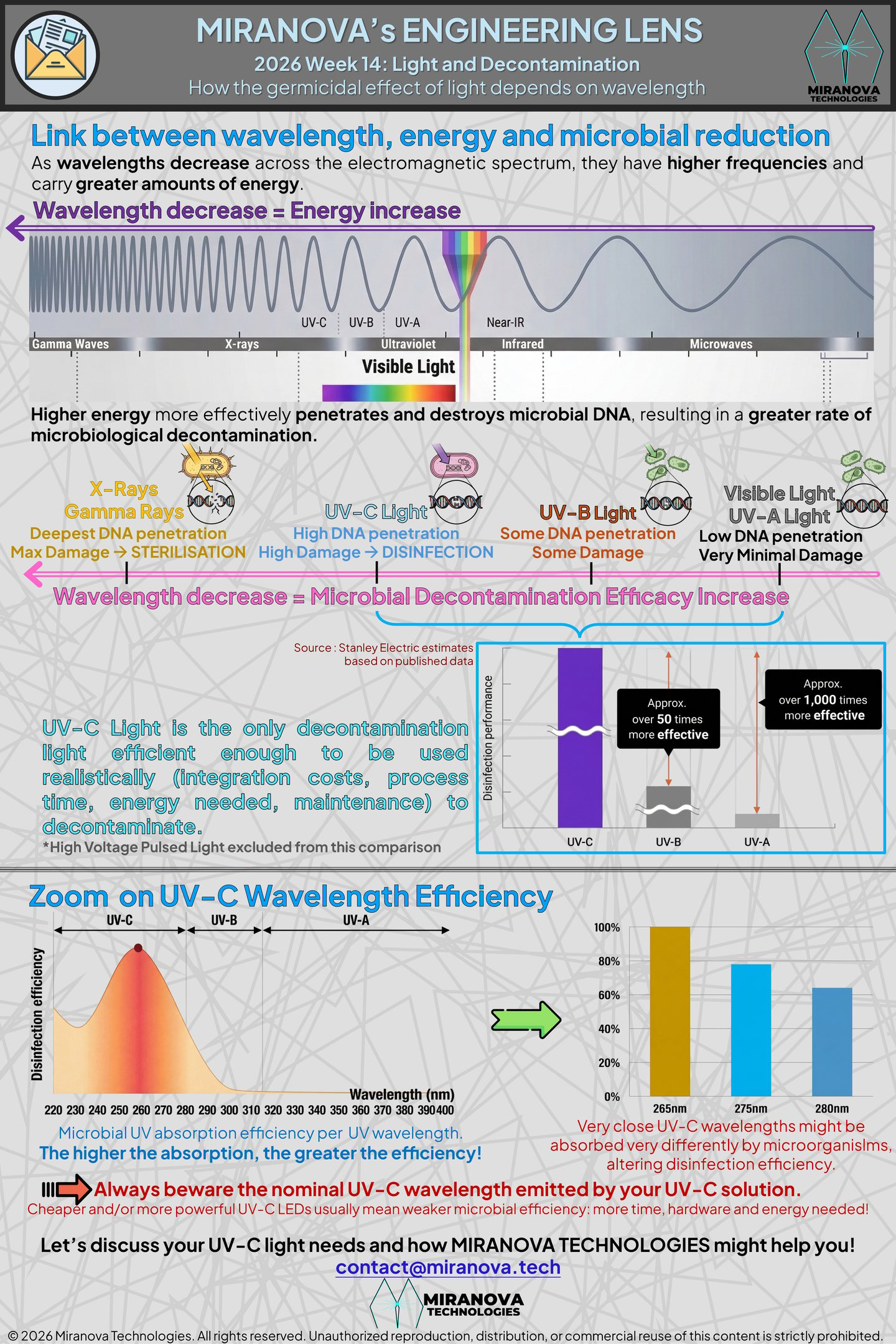
In hygienic machine design, accepting a decontamination solution based purely on top-line optical power is a costly trap. When dealing with UV-C light, raw numbers mean very little without their most critical context: wavelength.
As our latest Engineering Lens shows, germicidal effect is fundamentally tied to wavelength. Microbial DNA absorption peaks sharply around 265nm. If a solution operates just a few nanometers away from this peak (like 275nm or 280nm), the disinfection efficiency drops drastically.
The primary risk of ignoring this context is that a system that looks "powerful" on paper will actually deliver substantially weaker microbial reduction in reality. Engineers are then forced to compensate with longer process times, higher energy consumption, and bulkier hardware to achieve the required log reduction.
Always beware of announced facts that lack limitations. True hygienic design requires verifying the exact wavelength and understanding how it interacts with your specific microbial target.
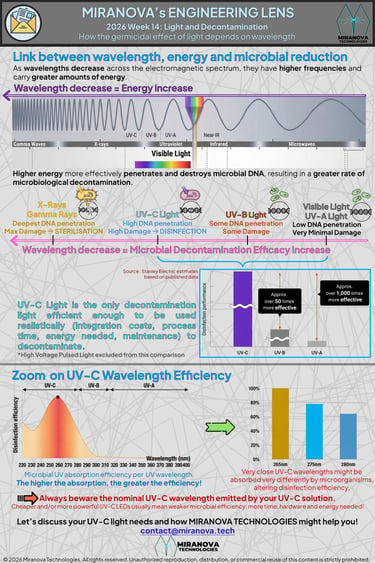
Click the infographic below to master the link between wavelength, energy, and microbial reduction.
As always, if you are facing a unique decontamination or efficiency challenge, just reach out to contact@miranova.tech to know more, and discuss further this topic!
Stay Informed
Get updates on machine design and UV-C solutions.
We send unique takes and in-depth analysis about Machine Design and UV-C Light every week.
MIRANOVA TECHNOLOGIES
Trelleborggade 8
2150 Nordhavn, Denmark
CVR-number: 46161963