🚀 Meet MIRANOVA TECHNOLOGIES at LOUNGES 2026 in Karlsruhe (March 24–26).🚀
Join us at the event for the latest in cleanroom & process technology! LOUNGES 2026 Karlsruhe - Cleanroom Processes



The Rise of UV-C LEDs
Discovery, Principles, Evolution and Limitations
4/7/2026
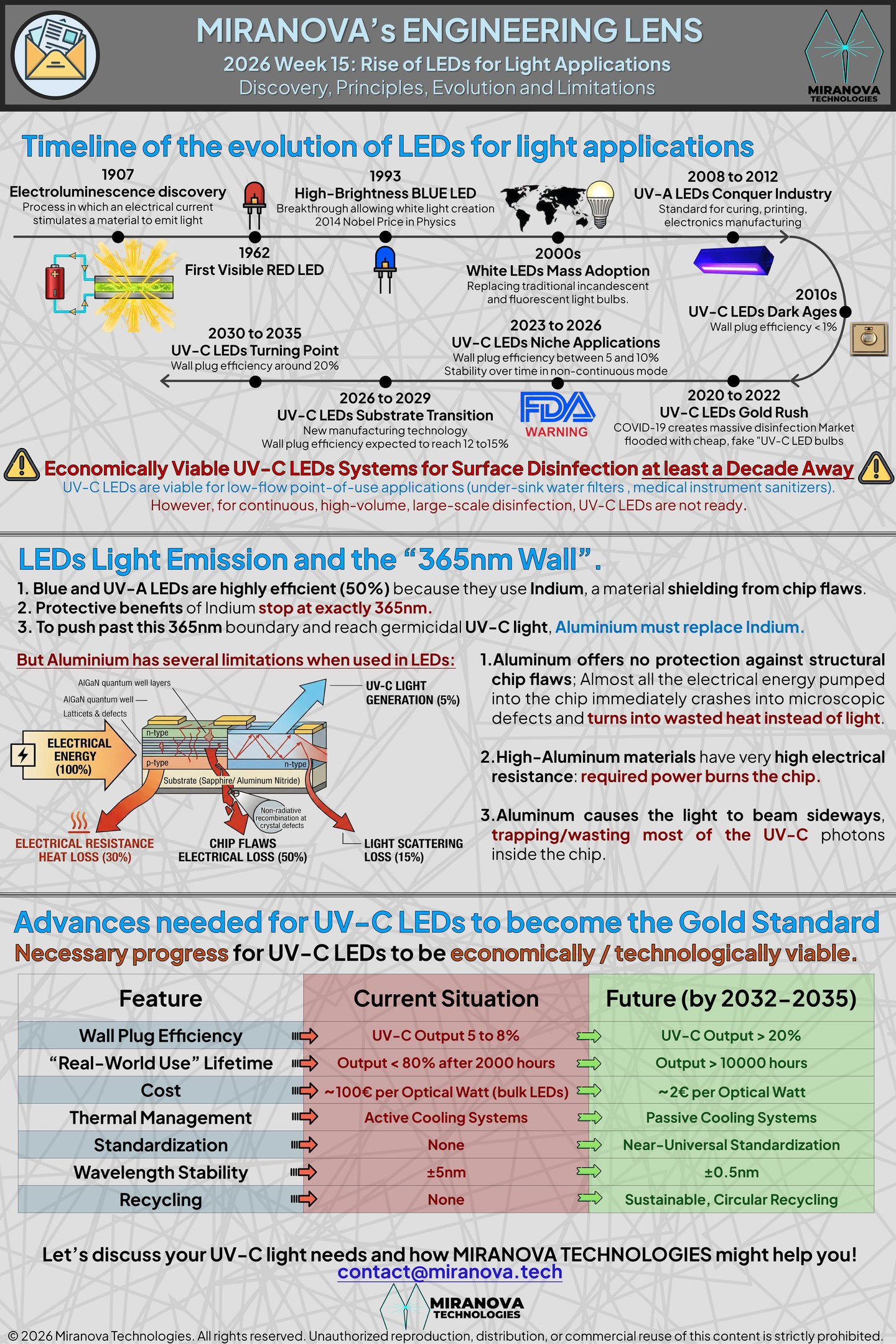
The LED Trap in Continuous Decontamination
With the oncoming regulatory phase-out of traditional mercury lamps, the market is aggressively rushing toward UV-C LEDs. It is easy to buy into the hype: they are mercury-free, compact, and turn on instantly. But blindly swapping mature low-pressure lamps for LEDs in high-volume, continuous machines is a massive—and costly—engineering trap.
As our latest Engineering Lens reveals, while UV-C LEDs are already reliable for low-flow, point-of-use applications, economically viable systems for large-scale surface disinfection are still at least a decade away.
Why the delay? It comes down to a hard physical barrier known as the "365nm Wall." To push past this natural limit and reach the germicidal UV-C spectrum, manufacturers are forced to use materials that trigger massive electrical resistance. The result? Over 90% of the electrical energy pumped into today's UV-C chips immediately crashes into microscopic defects and turns into wasted heat instead of light.
Before you invest heavy capital into an LED architecture that might look powerful on paper but fails to deliver at scale, you need to understand the true timeline of this technology.
Click the infographic below to master the timeline, the physical limitations, and the exact advances UV-C LEDs must achieve by 2035 to become the new Gold Standard.
As always, if you are facing a unique decontamination or efficiency challenge, just reach out to contact@miranova.tech to know more, and discuss further this topic!

Stay Informed
Get updates on machine design and UV-C solutions.
We send unique takes and in-depth analysis about Machine Design and UV-C Light every week.
MIRANOVA TECHNOLOGIES
Trelleborggade 8
2150 Nordhavn, Denmark
CVR-number: 46161963